Neuro-symbolic OCR & NLP for Classical Sinhala Ayurvedic Palm-Leaf Manuscripts
A three-module pipeline that turns photographs of centuries-old, faded palm-leaf manuscripts into text that is both readable and safe to act on — correcting OCR errors, detecting sentence boundaries, and screening for toxic ingredient guidance before a human ever sees it.
- My module
- Module 3 — Correction, SBD & Safety
- Team
- Team Vision (3)
- Supervisors
- Dr. Ganegoda G.U | Dr. R.L.C. Shyama
Abstract
Overview
Archaic Sinhala Ayurvedic palm-leaf manuscripts encode centuries of traditional medical knowledge, including formulations that can be toxic if a purification step is missed or misread. Team Vision built a three-module, neuro-symbolic pipeline to digitize them safely: image preprocessing and character recognition (Module 1), word segmentation (Module 2), and, as my contribution, post-OCR error correction, sentence boundary detection, and a knowledge-graph safety guardrail with human-in-the-loop (HITL) escalation (Module 3). The modules are connected only by a JSON interface contract, so each can be developed, evaluated, and swapped independently. My module is built around JointCS, a joint correction-and-segmentation model sharing a domain-adapted XLM-R encoder, wrapped in an orchestrator that fails closed: whenever the system is unsure, a human expert reviews before the reading is trusted.
The source material
What we're actually digitizing
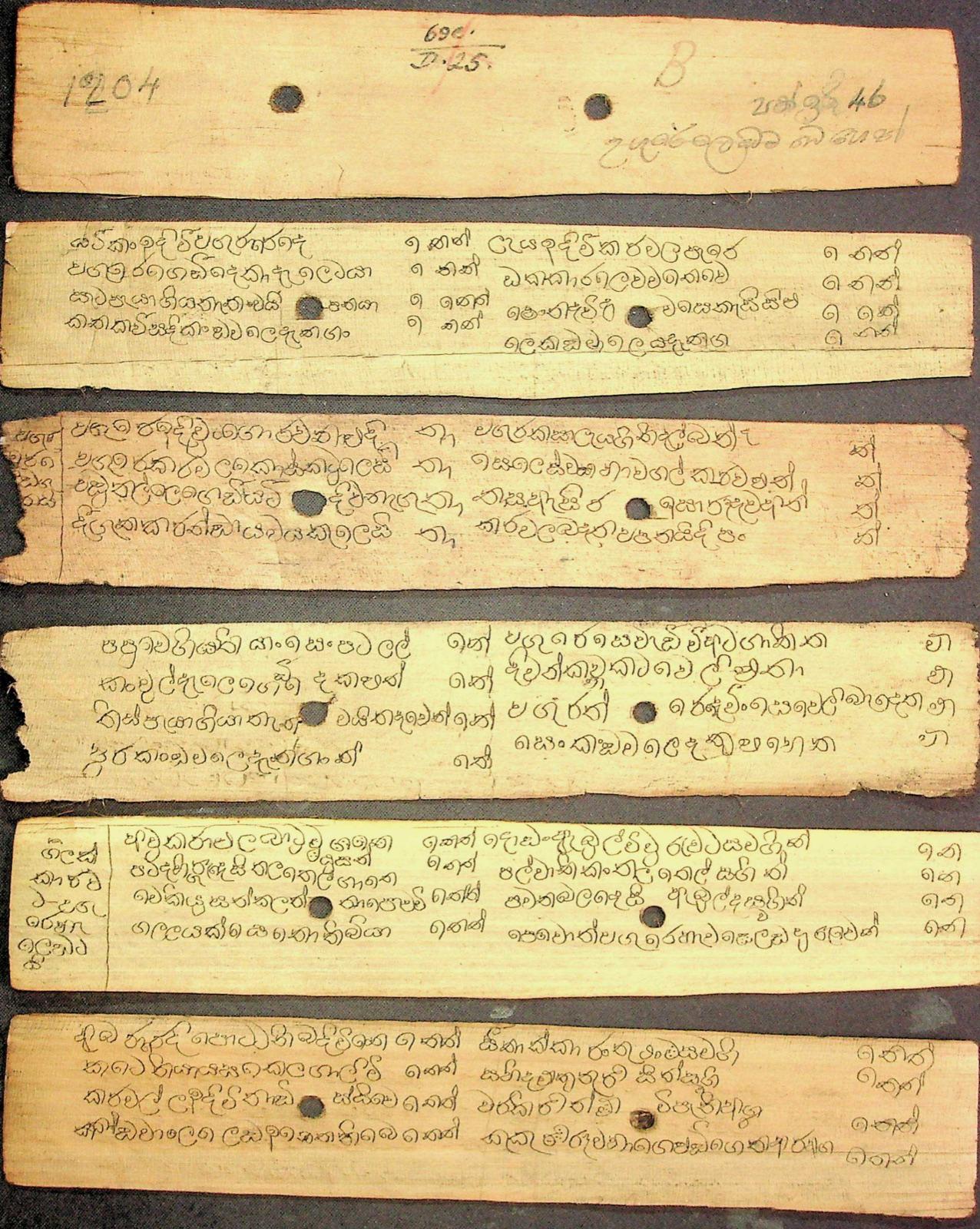
This is one board from a throat-medicine ola manuscript in the project's corpus — a real specimen, not a rendered mockup. Cursive Sinhala, written stylus-first into dried palm leaf, then rubbed with soot to make the incisions legible. On roughly half the ~95 leaf-sides surveyed, the ink has worn down to bare stylus scratches.
That's not a footnote — it's the reason Module 3 exists. Faded ink means OCR mistakes; a missed or misread purification step (shodhana) in a recipe for a toxic ingredient is a patient-safety issue, not just a transcription error. Correction, sentence-boundary detection, and the safety guardrail all exist to answer one question before a reading reaches an expert: how much of this can we trust, and where do we stop and ask?
Attribution
The team, and my role
This is a three-person group project. Everything below is scoped to Module 3, which I designed, built, and evaluated. Modules 1 and 2 belong to my co-researchers and are described here only for context.
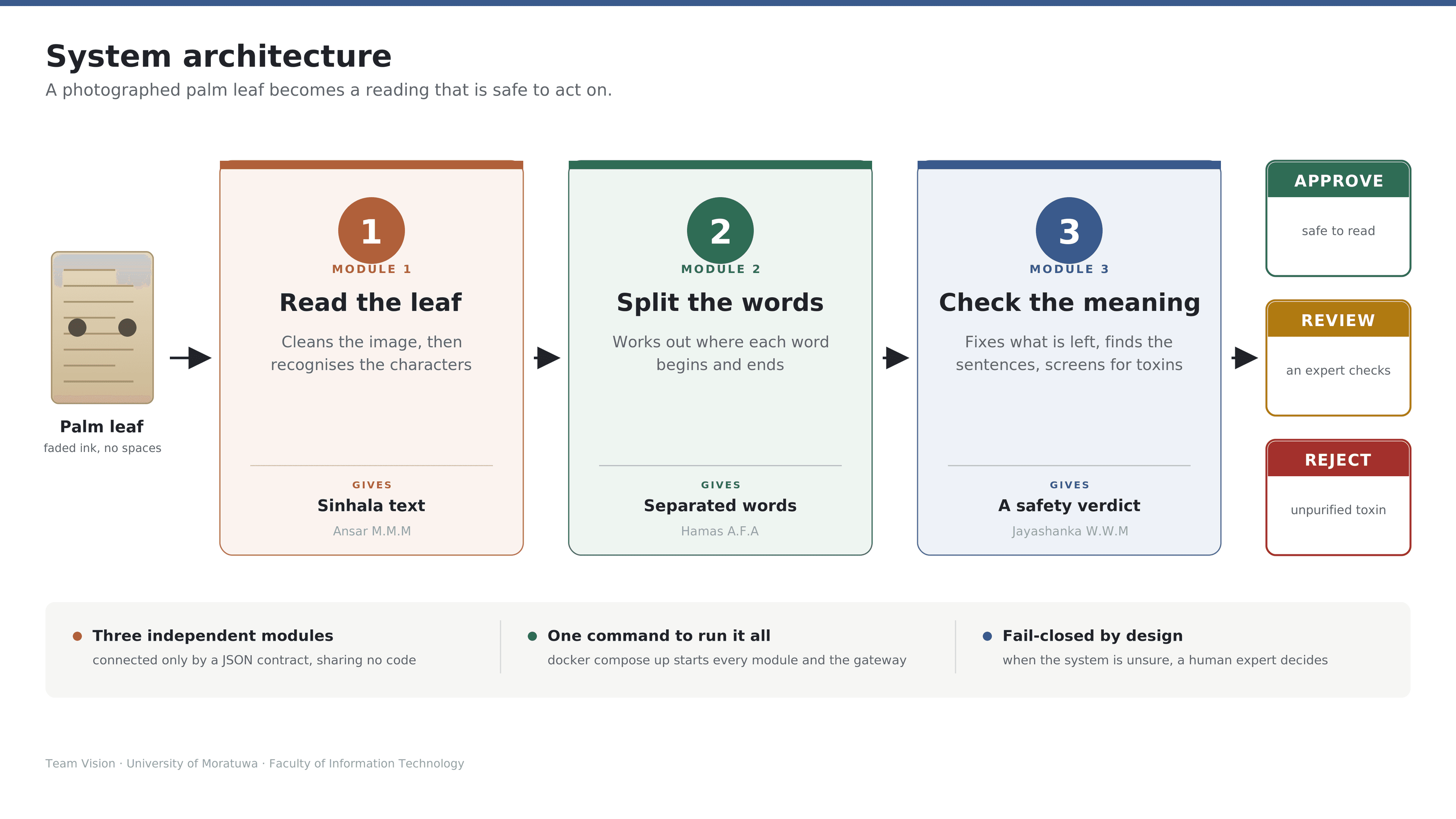
Read the leaf
Image preprocessing + CRNN/CTC character recognition baseline.
Ansar M.M.M
Split the words
Hybrid word segmentation, BiLSTM/BIES top-3 candidates.
Hamas A.F.A
Check the meaning
OCR correction, sentence boundary detection, KG safety guardrail, HITL orchestration.
Jayashanka W.W.M (me)
System design
Architecture
Three independent modules connected only by a JSON contract, run end-to-end with a single command, and designed to fail closed: when the system is not confident, a human expert makes the call instead of the model.
Method
JointCS & the safety guardrail
JointCS is a joint OCR error-correction and sentence-boundary-detection model: a shared, domain-adapted XLM-R encoder feeds three heads — a detection BiGRU, soft-masking in the style of Soft-Masked BERT, and a correction MLM head paired with an SBD head. Domain adaptation pre-training (DAPT) on Sinhala Ayurvedic text is what separates it from an off-the-shelf multilingual model.
To evaluate under realistic conditions, I built a seeded Sinhala glyph-confusion noise channel (substitutions, deletions, insertions, and split/merge errors) with four calibrated severity presets — measured character error rates of 4.8%, 9.6%, 14.7%, and 19.4% on gold text — so the model is never evaluated only on clean, synthetic input.
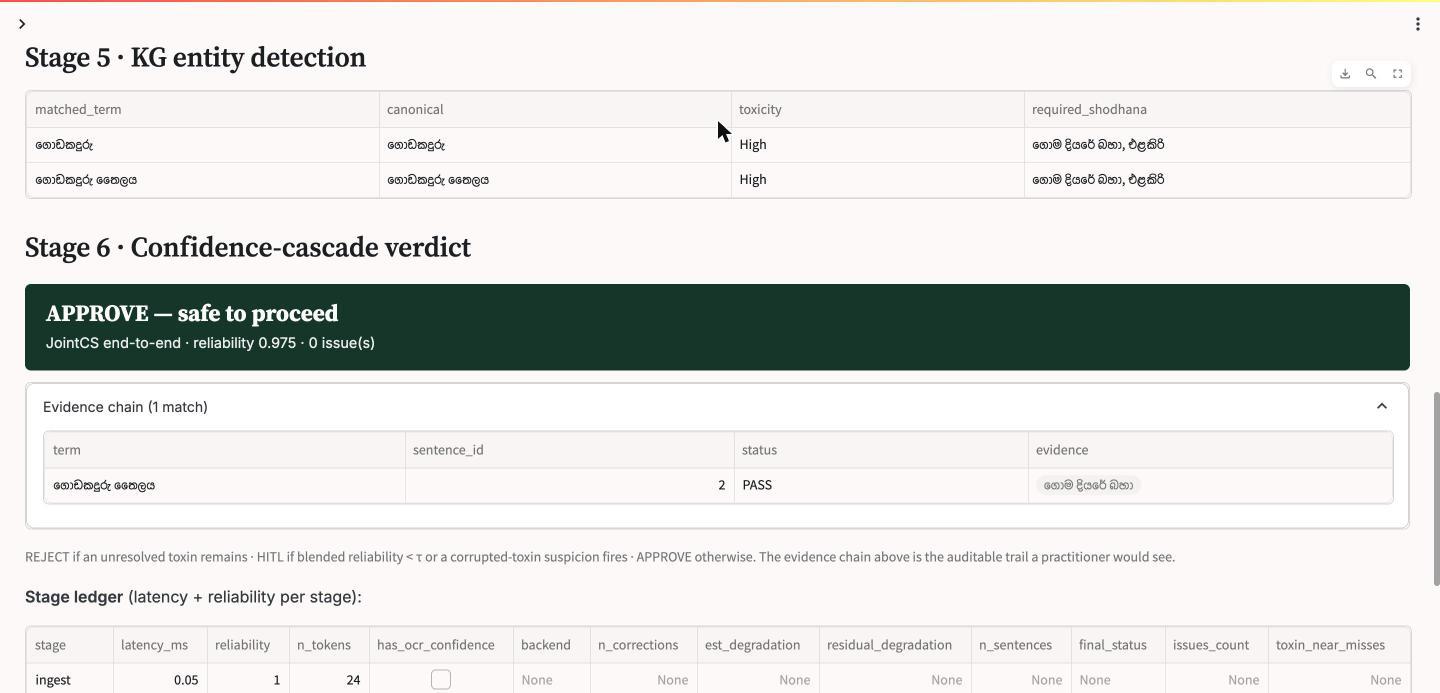
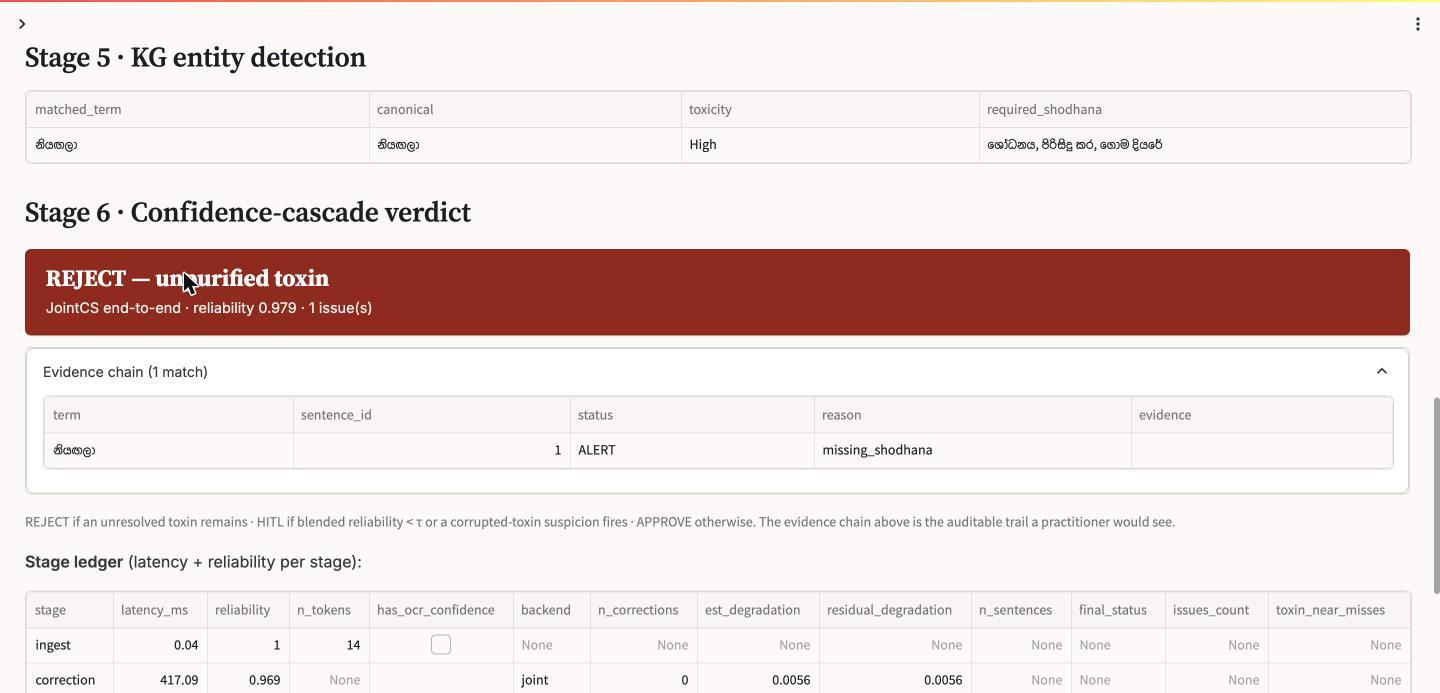
The riskiest failure mode isn't a wrong word — it's an unpurified toxic ingredient slipping through undetected. A 2,100-ingredient knowledge graph flags high/medium-high/medium toxicity entries, and a nearest-toxin binding rule ties each purification (shodhana) keyword to the specific toxin it modifies, rather than to any toxin in a nearby window — closing the exact failure mode that caused the two guardrail misses in the interim submission.
Live demo
Inside the orchestrator
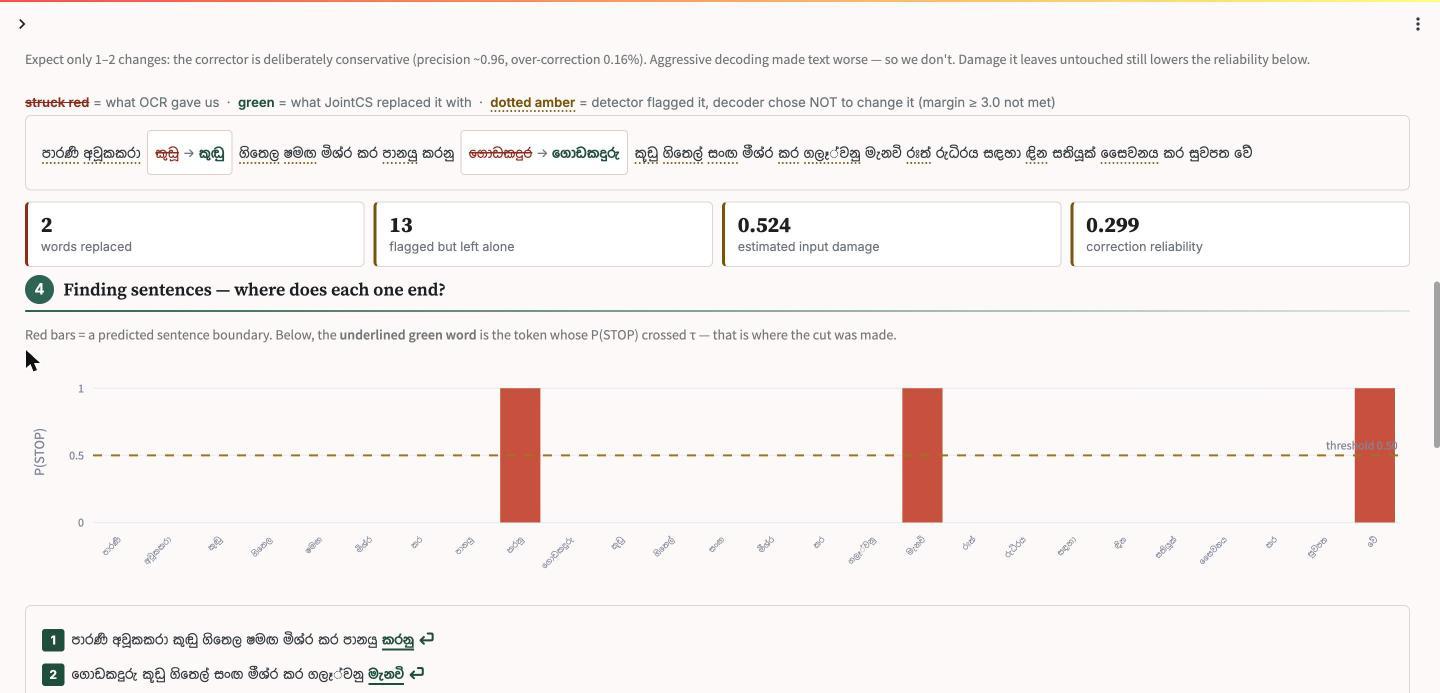
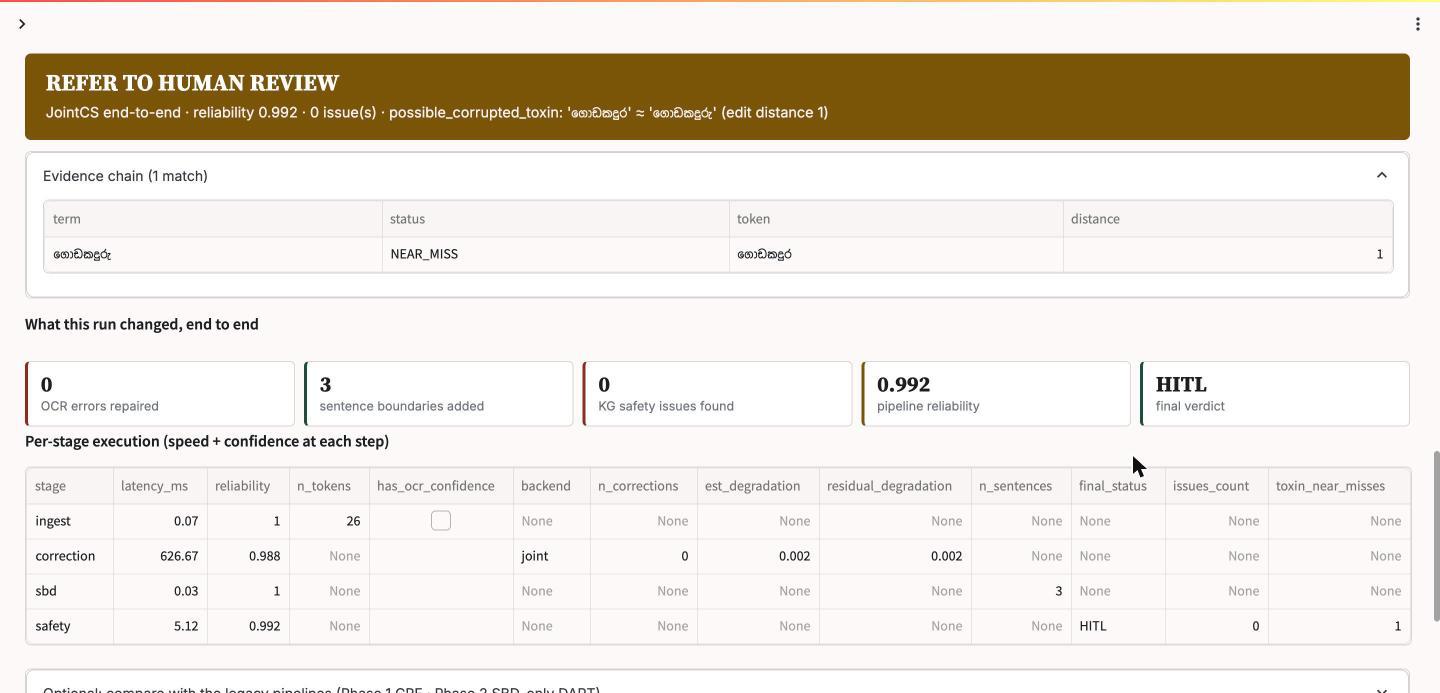
These are real captures from the Streamlit viva demo running the live pipeline — not mockups. Each shows the orchestrator reasoning over an actual manuscript sentence, in Sinhala, end to end.
Evaluation
Headline results
All numbers below are from the hardened evaluation protocol (holdout benchmark, multi-seed, reproduced byte-identically across three independent runs) — not the earlier, in-corpus-inflated numbers.
Pre-registered
Hypothesis scoreboard
Four hypotheses were pre-registered in the methodology before the final evaluation ran. All four are reported below, including the ones that only partially held.
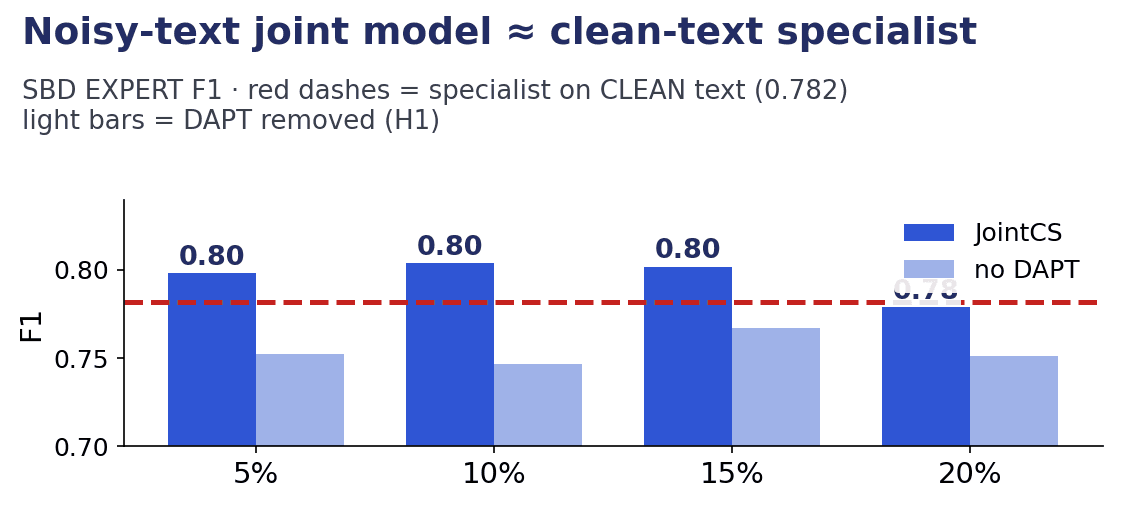
Noisy-input SBD (F1 0.798–0.804) is statistically equivalent to a clean-text specialist (0.782) — equivalence, not superiority. The cleaner, significant effect is the DAPT ablation: removing domain-adapted pretraining costs 2.8–5.7 F1 points, consistently, at every noise level.
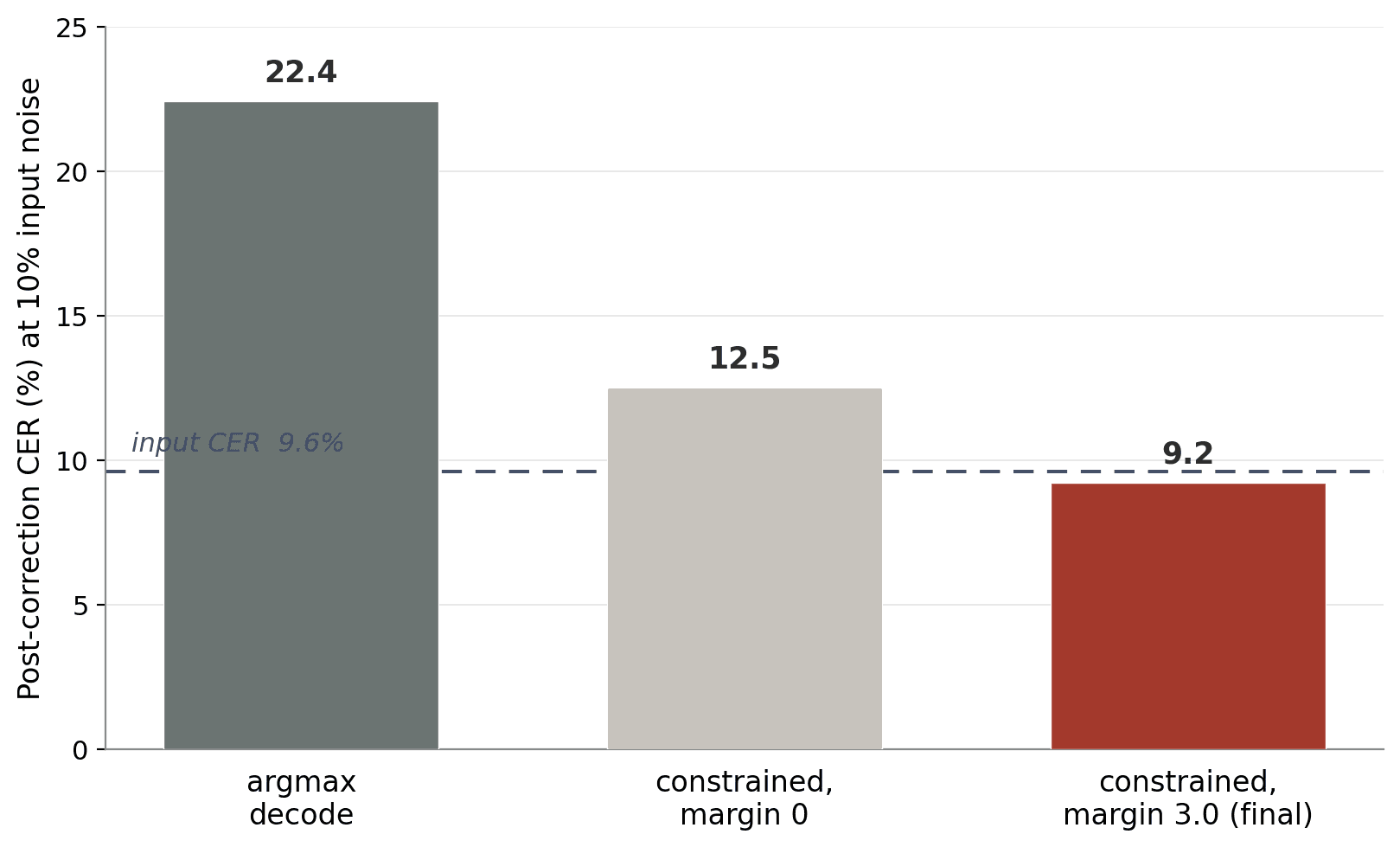
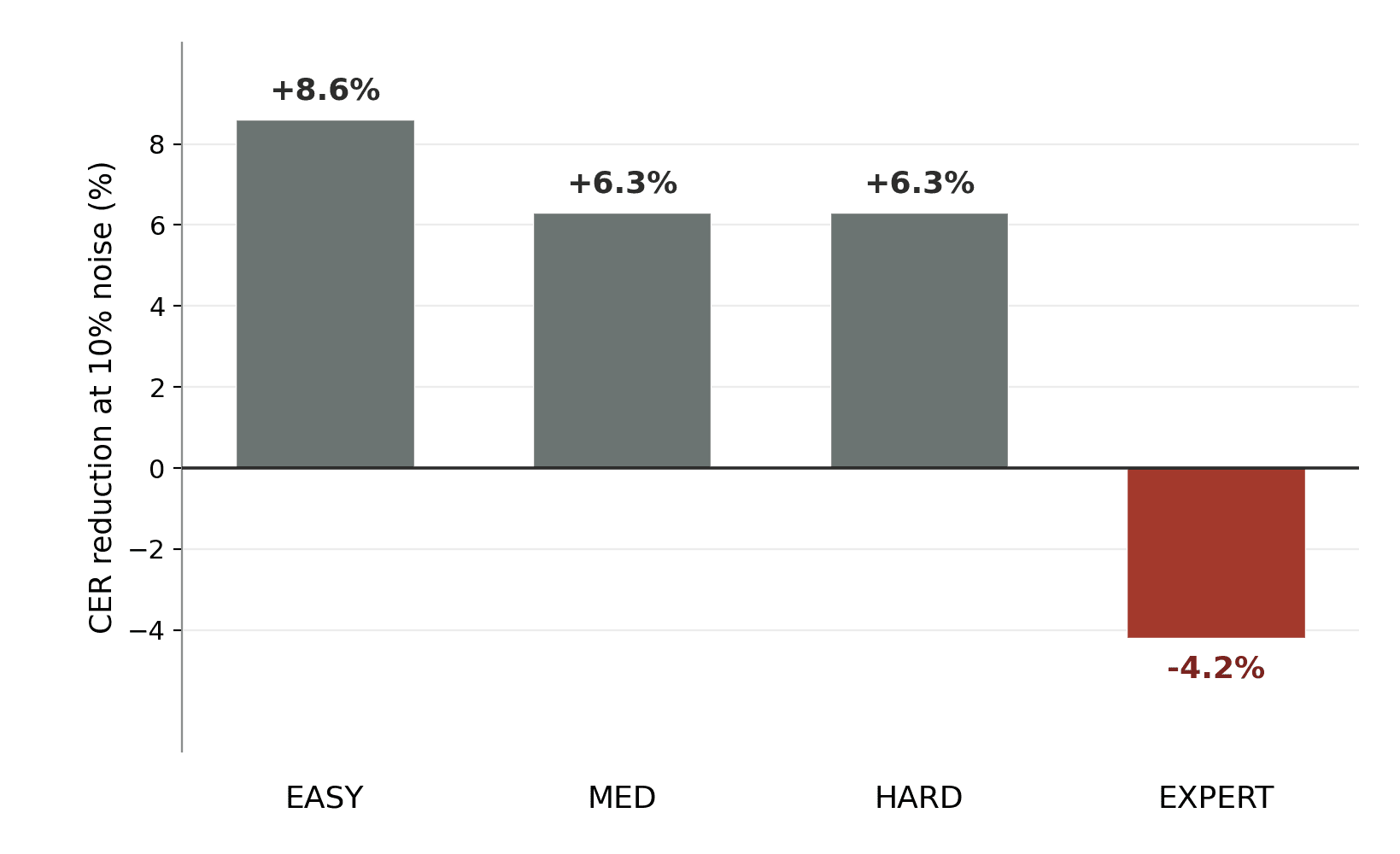
Correction gives a net CER reduction at the calibrated decision margin (3.0), confirmed on a held-out calibration split with no leakage — with the EXPERT-bucket exception reported above.
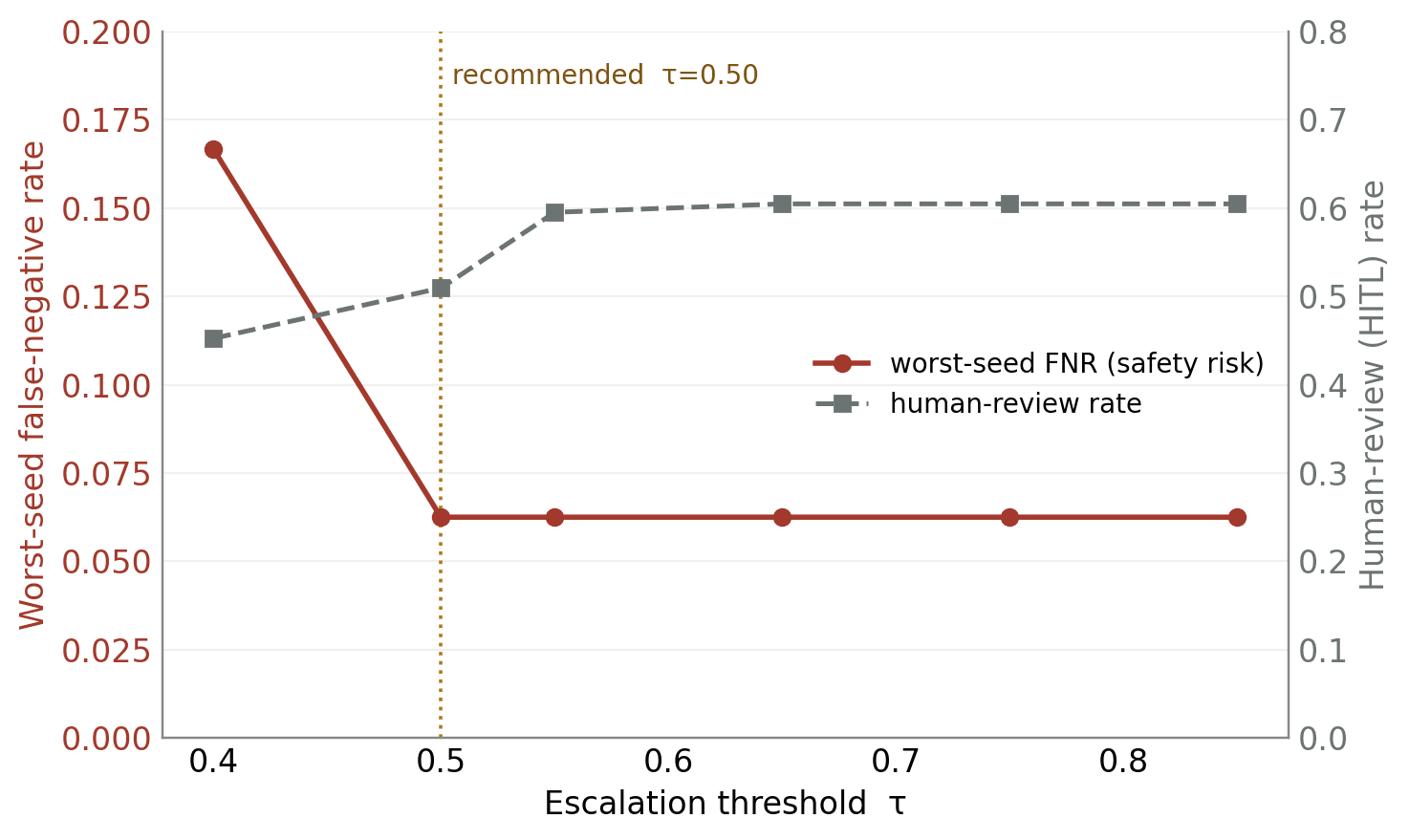
Zero toxic approvals observed on clean text (bounded, not exact, at n=28). The system stays a fail-closed HITL triage tool rather than a certified filter: end-to-end verdict accuracy drops below the 0.90 target at 15%+ noise, where residual misses trace to OCR-corrupted toxin surface forms, not knowledge-graph coverage gaps.
Expected calibration error stays under 0.01 across all noise levels (max 0.0094) — the model's confidence scores can be trusted to drive the HITL escalation decision.
Honesty
Limitations
- The 70K-sentence training corpus has only 205 unique word types across 782K tokens — it's templated, not naturally varied. In-corpus evaluation numbers are inflated; the out-of-corpus EXPERT bucket is treated as the only real signal throughout.
- The OCR noise channel is synthetic. Severity presets are calibrated to match measured CERs on gold text, but a separate run against three manuscript-attested confusion pairs (real scribal error patterns) was used to sanity-check robustness — headline metrics held, correction gains were slightly smaller.
- Main results come from a single training seed, disclosed wherever cited. A parallel run completed the formal joint-vs-SBD-only ablation with one seed; multi-seed confirmation is future work.
- Inter-annotator agreement and domain-expert validation studies were descoped as infeasible within the project timeline — reported here as an explicit limitation, not silently dropped.
- The safety guardrail is a bounded, fail-closed triage aid, not a certified toxicity filter — framed that way throughout rather than oversold.
Where it stands
Status & deliverables
Final evaluation
Physical exhibition mode following Semester 8 exams — exhibit, submitted materials, and a viva-style discussion of individual contribution.
Deliverables in progress
Group final report, a 15-minute presentation video, an exhibition poster, and slide deck alongside the Streamlit viva demo.
Publication
Results are being written up as an IEEE conference paper, with LREC 2026 as the leading target venue.
Happy to talk through the methodology, the guardrail design, or the evaluation protocol in more depth.
Get in touch